



Request Lorem Epsom
Hero Request Form
Thank you for contacting us.
We will get back to you as soon as possible.
Please try again later.
Ophthalmic Equipment Service & Support
MEDiSURG supports ophthalmic surgery centers with a complete, end-to-end approach to equipment lifecycle management. The company buys and sells high-quality ophthalmology systems, offering reliable options for facilities looking to upgrade or expand their capabilities.
Alongside equipment sales, MEDiSURG supplies dependable replacement parts and delivers expert service to keep phaco and vitrectomy surgical equipment performing at their best. Their preventative maintenance programs further strengthen system reliability, helping teams reduce downtime, extend equipment life, and maintain safe, efficient surgical environments. Call us today.
Buys and Sell
MEDiSURG supports surgical facilities by offering reliable options for both purchasing and selling ophthalmic equipment. Their team helps centers upgrade technology, expand capabilities, or responsibly transition out of older systems, ensuring every piece of equipment meets high standards for performance and safety. With decades of industry experience, MEDiSURG guides customers through informed decisions that align with clinical needs and long‑term operational goals.
Parts
MEDiSURG provides high‑quality replacement parts designed to keep phaco and vitrectomy systems operating at peak performance. Their inventory includes dependable components sourced to meet strict technical requirements, helping facilities maintain consistency, safety, and uptime. By offering expert guidance on part selection, MEDiSURG ensures teams receive the right solutions quickly and confidently.
Service
With more than 75 years of combined technical expertise, MEDiSURG delivers fast, precise service for ophthalmic surgical equipment. Their technicians diagnose issues accurately, perform repairs to manufacturer‑level standards, and support teams with responsive communication throughout the process. Whether addressing urgent failures or fine‑tuning system performance, MEDiSURG’s service approach keeps surgical environments running smoothly and safely.
Preventative Maintenance
MEDiSURG’s preventative maintenance programs help surgical teams avoid unexpected downtime and extend the life of their equipment. Through scheduled inspections, calibration, and performance checks, their specialists ensure phaco and vitrectomy systems remain reliable and compliant with clinical standards. This proactive approach gives facilities confidence that their equipment will perform consistently during every procedure.
Why Choose Us
Specialized Ophthalmic Expertise
Full-Service Equipment Support
Precision Service & Maintenance
Over 75 Years of Combined Experience
Services Available in 24 Hours
High-End Equipment

Surgical Instruments
Our surgical instruments collection features high-quality tools for various surgical specialties. From basic surgical kits to specialized instruments, we offer durable, precision-engineered tools that meet the exacting standards of modern surgical practices.

Ophthalmic Surgical System Training
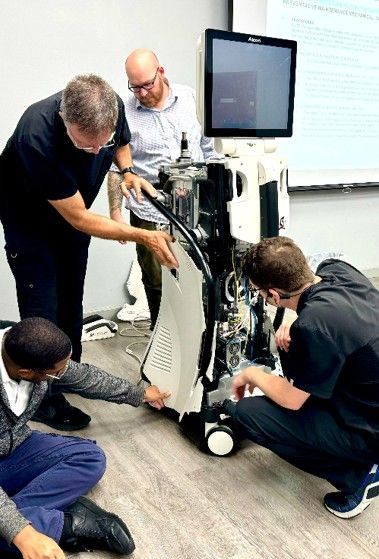
Whether you prefer hands‑on workshops, live Zoom training, or on‑demand online courses, we offer instruction tailored to technicians, biomedical engineers, and surgical staff.
Don't delay. Contact MEDiSURG Today to Begin Your Training Sessions
Our Recent Projects


Here's what our satisfied patients are saying...
At MEDiSURG, we take pride in providing exceptional medical supplies to our patients. We would be grateful if you could share your thoughts about our business with others. Your feedback helps us improve and helps others make informed decisions. Please take a moment to leave a review of MEDiSURG and let others know what you think.
Frequently Asked Questions
Navigating the equipment lifecycle requires making strategic choices about asset acquisition, parts replacement, and ongoing maintenance. We understand that managing a comprehensive inventory of delicate medical platforms, such as specialized vitrectomy surgical equipment, can be highly demanding for administrators and clinical directors alike. To help your facility make well-informed choices regarding your procurement and service strategies, we compiled answers to the questions most frequently asked about managing high-end surgical investments.
What factors should an ophthalmic facility consider when looking to sell or trade in their older surgical systems?
When a surgical facility decides to upgrade its operating rooms, liquidating or trading in older technology is an excellent way to recover capital and offset the cost of new investments. Administrators must carefully evaluate the current market demand and physical condition of their outgoing machinery to ensure they receive a fair, realistic valuation. It is essential to work with a partner who understands the intricacies of sensitive vitrectomy surgical equipment so the true value of the technology is accurately assessed. Facilities should also consider the timing of the transition to ensure there is absolutely no gap in equipment availability that could disrupt scheduled patient procedures.
Another critical factor to review is data security and the proper removal of any patient tracking information stored on internal hard drives before the machine leaves the building. Choosing a provider that handles both the logistics of deinstallation and the acquisition of replacement systems simplifies the entire process. This dual approach cuts down on administrative paperwork and avoids the hassle of coordinating with multiple third-party liquidators. Ultimately, a successful asset transition should free up valuable storage square footage while providing immediate financial flexibility for your facility's upcoming technology upgrades.
Why is it essential to source replacement parts from a provider with extensive technical experience in ophthalmology?
Sourcing internal components for specialized eye surgery platforms is highly critical, as even the smallest mechanical variance can profoundly alter the dynamics of a delicate procedure. Providers with deep, focused knowledge in the ocular sector understand that generic, unverified parts often fail to interact correctly with proprietary software and complex fluidic loops. When repairing sensitive vitrectomy surgical equipment, using components that are meticulously vetted and bench-tested ensures that vacuum and cutting parameters remain totally stable. Experienced specialists know exactly how individual valves, seals, and circuit boards impact the performance of the entire machine footprint.
Partnering with an experienced supplier also eliminates the risk of ordering incorrect or outdated part numbers, which can lead to frustrating shipping delays and extended equipment downtime. These specialized professionals can offer valuable technical guidance during the selection process, ensuring your internal team receives the exact component needed for a lasting fix. High-quality parts prevent premature wear and tear on surrounding internal mechanisms, protecting your capital investments from cascading technical failures. Prioritizing verified part quality directly translates to consistent machine behavior and reliable operating room performance.
How does an end-to-end approach to equipment lifecycle management benefit a busy ambulatory surgery center (ASC)?
Ambulatory surgery centers operate in a high-volume, fast-paced environment where operational efficiency and cost control are central to everyday success. Adopting an end-to-end lifecycle strategy means a single partner handles everything from the initial acquisition and routine preventative maintenance to emergency repairs and final asset trade-ins. For complex machinery like vitrectomy surgical equipment, this comprehensive oversight ensures that every service milestone is meticulously tracked, documented, and executed on schedule.
This integrated approach significantly minimizes unexpected equipment downtime, which directly protects the center's daily surgical revenue and patient throughput. It allows facilities to transform unpredictable emergency maintenance expenses into structured, predictable operational costs over the lifespan of the technology. When the time eventually comes to phase out an older system, the transition is seamless because the provider already knows the service history of the machine.
Recent Blog Posts